
Catching up with a friend after returning to Tokyo from a month in Vietnam, she told me that she wanted to visit, too — but was worried about getting food poisoning.
Her concern was fair enough. Hot climates lead to faster spoilage, food safety standards are not the same everywhere, and there are GI horror stories even from popular spots that see high turnover. It’s easy to take potable tap water and a strict supply chain for granted — just compare foodborne illness statistics in the US before and after Trump gutted every federal food and health agency.
And as an anxious control freak with nearly two decades of OCD and a long hypochondriac streak under my belt, I felt qualified — no, obligated — to put her mind at ease. I imagine there are other travelers out there seeking similar advice, so I decided to publish what I shared with her.
A few necessary disclaimers: I am not a doctor, nutritionist, food scientist, or holder of any other qualifications that would make me an authority. Some of this is evidence-based, and some of this is pure conjecture. I’m only sharing what I did, so please sound off in the comments if I got something terribly wrong. We aren’t peddling Ivermectin here.
The qualification I do have? In five months of solo travel across East and Southeast Asia, I ate everywhere from Michelin restaurants to street stalls, and never once got sick. The spirit of Anthony Bourdain, and the dry probiotic regimen I nuked my stomach with, protected me from harm.
So here’s all the advice I sent her.
Before the trip
Buy travel insurance.
Seriously. It’s cheap relative to a potential hospital bill. Check with your card issuer first to see if they offer any options, and then look into the part of the world you’re visiting as local options are sometimes cheaper.
Purchase this well before the trip date to get a proper read on the policy and ensure coverage for pre-existing conditions.
Get your vaccines.
Full disclosure, I think this can be overkill if you’re sticking to major cities – you don’t need to become a human pincushion over a week in Hanoi.
Your best bet is to consult with a travel clinic, because recommendations will vary based on your destination. But here are a few off the dome for SEA:
Hepatitis A: Protects against Hep A, a liver infection that can spread through contaminated food and water. If you aren’t yet fully immunized, ask about the Hep A & B combo vaccine, because Hep B is recommended for SEA as well.
Typhoid: Protects against typhoid fever, which is caused by some strains of salmonella.
Dukoral: Protects against cholera and ETEC, bacteria that are usually transmitted through poor food sanitation.
Build a go bag.
You’ll feel a lot more at ease if you’re not hunched over a toilet in your hostel totally unprepared while your gut reenacts an Olympic floor routine.
Wet wipes: Do not flush them unless the packaging explicitly says they’re flushable, and then do not flush them anyway. Your bowels may be in crisis, but the plumbing does not need to join them.
Portable soap: Because nothing beats washing your hands, and sometimes soap isn’t available in restrooms. I carried around soap sheets like these as they’re the most portable option. You can also grab a dropper from your local pharmacy and fill it with liquid soap, or dice/shave a bar of soap and keep it in a little container.
Alcohol wipes: Wash your hands with soap and water when you can. When you can’t, use these. They’re also useful for wiping down utensils and surfaces.
Oral rehydration salts: Diarrhea and vomiting are dangerous because they dehydrate you. Gatorade and Pocari Sweat can also be good for mild electrolyte replenishment, but ORS packets are more heavy-duty and portable.
A small thermometer: Because “do I have a fever, or am I just anxious and damp?” is a question best answered with a device, not a panic disorder. Speaking from experience.
Imodium/loperamide: Anti-diarrheal medication. For use in emergencies, like before a long flight or bus ride. You should not be taking this regularly because it can lead to constipation. It also shouldn’t be taken if you’re seeing any blood or have a fever – that warrants a visit to the hospital. But it can be a lifesaver if your stomach refuses to settle.
Pepto-Bismol/bismuth subsalicylate: Helpful for some cases of mild stomach upset or traveler’s diarrhea. I’ve heard of folks taking it before their first meal in a new country to line the stomach with something soothing. Almost like a buffer. But check the label first – it’s not for everyone, especially if you’re allergic to aspirin, on certain medications, pregnant, or dealing with certain medical conditions.
Zofran/ondansetron: If available. I believe this is usually prescription-only, but it’s a total lifesaver against nausea.
Antibiotics, IF recommended: Check with a travel clinic to see if you should take these where you’re going. I’d only recommend it if you’ll be somewhere super remote where an immediate pharmacy or clinic isn’t available, as irresponsibly-taken antibiotics can lead to resistance.
Probiotics?
Effectiveness debatable, but I like to cover my bases, so I took them. The logic here is that you’re building a healthier gut microbiome to make it more resilient when introduced to new bacteria in food and water abroad.
While I was in Thailand, I picked up something called Normagut from a pharmacy. It contains Saccharomyces boulardii, a probiotic yeast that has been studied for traveler’s diarrhea. It comes in a dry capsule form that you break open and dissolve in a drink. There are also liquid probiotics available, but dry is generally considered to be more shelf-stable, which is important when you’re traveling.
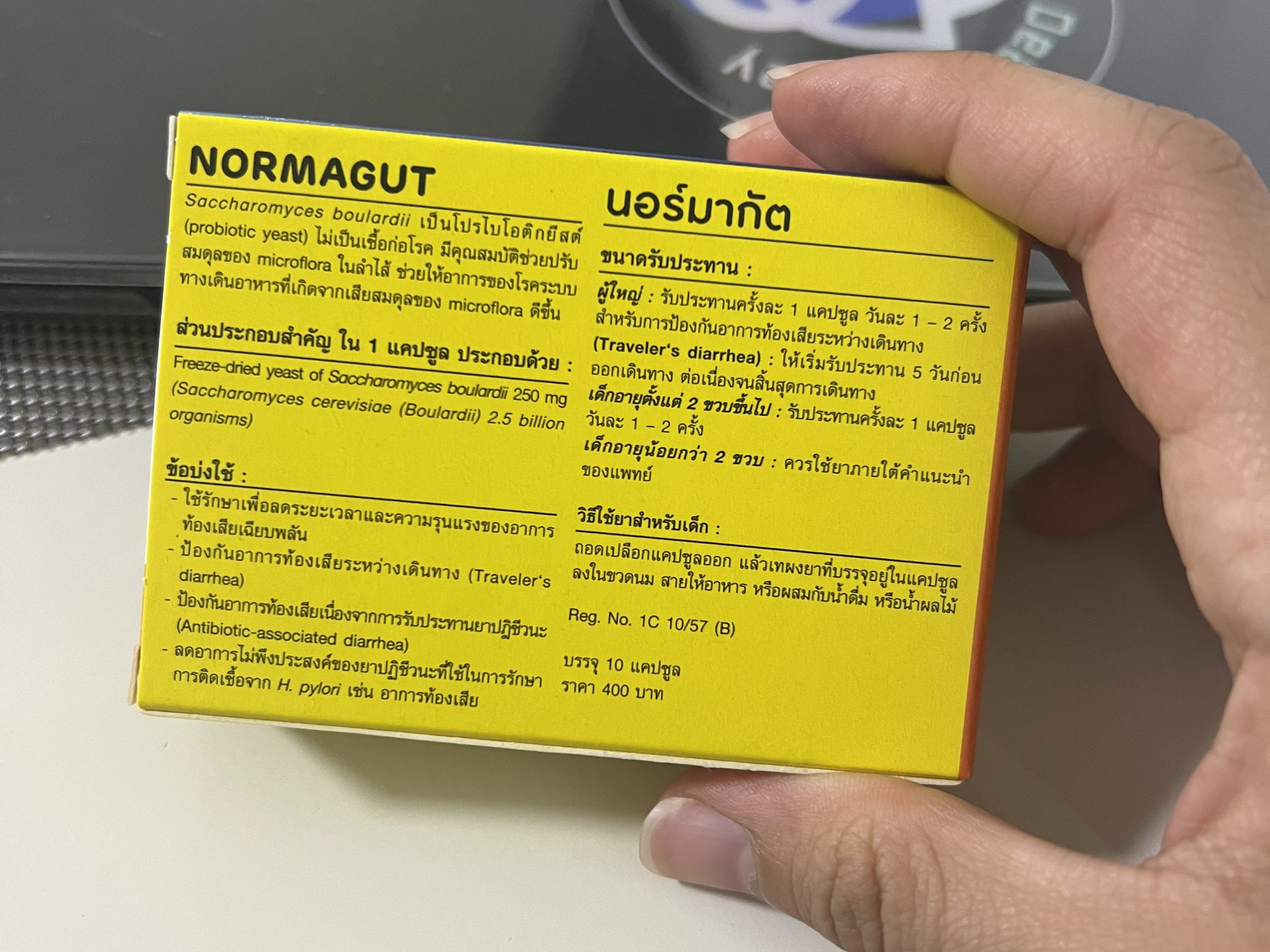
Start taking them before your trip and continue during. I started a week before and continued them during my first week in Vietnam, then stopped as I felt my stomach had enough time to adjust. Don’t force yourself to keep going if it doesn’t feel good — the initial dosage was too high for me, so I pared it down.
And probiotics are not, like, a multivitamin you can just test drive. If you’re immunocompromised or have any chronic medical conditions, consult a doctor first.
During the trip
Stick to fully cooked foods the first few days.
Give your stomach time to adjust before introducing new microbes. I didn’t touch any raw herbs or vegetables (a herculean task in Vietnam) for my first few days in the country. A good first meal is a cooked noodle soup with blanched vegetables.
Follow the crowd.
That means sticking to common meal times and going to places that are popular with locals. People will not eat where they got sick, and busy meal times means high turnover, which means less of a chance for food to sit out and spoil. And I promise you the empty Western restaurant where you’re the sole customer is way more likely to have you retching out your lunch than the bún riêu spot with a line out the door.
Watch it get made.
Trust your eyes. Thrown into the pot, grill, or fryer right in front of you? Gorgeous. You’re witnessing a pathogen massacre in real time. And when you can see the food getting made, you get a first-rate endorsement as to whether the establishment is clean and the food is being handled responsibly.
This is why street food is usually safer than your fear makes it feel: if the stall is busy, the ingredients look fresh, and your food is being cooked hot to order, that’s a much better sign than the lukewarm hotel buffet or 7-Eleven oden that have been sitting under heat lamps in wait for their next victims.
Google is not gospel.
Some places farm 5-star reviews in exchange for a discount or free drink, so you can’t rely solely on Google Maps to find truly reliable spots. Beli is safer, but you usually just see an aggregate user average rating there, not individual reviews. (If you want to see all the spots I visited with reviews, you can follow me @ayahokay).
Eat locally-made yogurt.
I started doing this after I stopped taking the probiotics, as it’s easy enough to have with your breakfast and keeps that healthy gut microbiome active.
Peelable fruit is your friend.
Be wary of any pre-cut fruit that may have been washed in local tap water, which isn’t safe to drink. Grab whole fruits that you can peel yourself: that would be bananas, mangosteen, longan, lychee, rambutan, custard apples, durian, dragonfruit you’re cutting, and the like.
Lukewarm is your enemy.
Hot food should be hot and cold food should be cold. No centrist shit when it comes to food temp. That’s where the bad stuff multiplies.
Check and clean your utensils.
Sometimes they aren’t washed properly. Check the container they’re kept in to see if it’s clean as well – sometimes vendors will put chopsticks in skinny-side up to prevent contact with the bottom. I always wiped them down with alcohol wipes anyway — I also saw people using the lime wedges that are left on the table. I don’t really know how effective this practice actually is, but I will say the one time I forgot to do this, I dealt with a sore stomach for a couple hours afterwards.
Brush your teeth with bottled water.
Tap water isn’t safe to drink in some countries, and if you have a sensitive stomach, it’s best to go the extra mile. I stopped bothering with this after several weeks in the region and was fine, but better safe than sorry.
Ice in drinks.
Some online tips for Vietnam say to avoid ice in your drinks because it might be made from local tap water. I think this is less “always avoid” and more “use your judgment”, especially nowadays. Factory-made ice is becoming a lot more ubiquitous now, especially in major cities. You can usually tell if the ice in your drink is factory-made if it’s round and has a hole in the middle. It was never an issue at any cafe or restaurant I went to.
Practice caution if you see crushed ice, or ice that has been sitting out in buckets.
Check the seals.
I’ve mentioned enough times that tap water isn’t safe to drink in some countries. You may need to double-check the seals on your bottled water too. I don’t mean to encourage this much neuroticism, but sometimes they are refilled with tap water. You don’t need to be doing this at the local 7-Eleven, just be mindful.
Stuff to avoid, if you want to be extra careful.
I don’t believe in limiting yourself out of fear. But here’s a list of riskier items if you want to take the extra step.
Raw shellfish, including oysters: You don’t need me to explain this, do you?
Raw or undercooked seafood: See above.
Snails and clams: It’s difficult to tell if they weren’t already dead when cooked.
Bean sprouts: I know…I love them too, but they’re notorious for being rife with bacteria even in countries with strict food safety standards. It’s because of how they’re grown.
Lettuce and raw leafy greens: I avoid lettuce at home. Honestly. I sling back raw oysters on, like, a biweekly basis and won’t eat lettuce unless I washed it myself. But I DID eat it in Vietnam…as bánh xèo is nothing without a little lettuce wrap…
Sugarcane juice: Machines handling sugary things are never cleaned properly anywhere in the world — hell, look at the dark underbelly of a McDonald’s ice cream machine in any western country. Sugar is the perfect breeding ground for bacteria, the climate is hot, and you aren’t even missing much anyway. I had it once in Singapore and it wasn’t that good! I think it could be fantastic with something like lime juice to brighten it up…on its own it’s just sweet.
Be careful about unregulated alcohol in Southeast Asia.
I’m not saying to forego the cocktail bars — please don’t, two of my favorites in Asia are in Ho Chi Minh City. But exercise some caution throwing back shots at your party hostel – bootleg alcohol, which can lead to methanol poisoning, is a real risk in some parts of the world. The danger clusters around free or cheap shots, “buckets,” street-side moonshine, unlabelled bottles, refilled liquor bottles, and suspiciously cheap branded spirits.


If you want to drink comfortably, stick to reputable bars and restaurants, or grab something sealed: beer, cider, canned drinks, or spirits from a trustworthy shop. Don’t be afraid of drinking, just don’t make mystery liquor from a bucket the hill you die on. The Friday Beers cohort needs you safe and healthy.
Wash your hands.
It’s obvious, which is why it bears repeating. Especially after handling cash, which you will do often.
Activated charcoal tablets?
I did not use these, but some travelers recommend taking them before eating at sketchy places. The logic is that activated charcoal can bind to certain toxins in your digestive tract, which is why it’s used medically in some situations involving overdose or poisoning.
But charcoal binds to, um, everything. So don’t use it regularly, and be especially careful if you take medication — including birth control, antidepressants, antibiotics, heart meds, seizure meds, or really any regular oral medication. This isn’t something you should freestyle without properly understanding the risks.
Plan ahead for emergencies.
Take note of English-speaking clinics ahead of time, if available. Keep a list of your symptoms and when they started. Download the local language offline on your translation app of choice, in case coverage is spotty when you need to communicate with medical personnel.
Got sick? Hydrate first. Oral rehydration salts are ideal, but electrolyte drinks, broth, and water are all better than nothing. Then, eat gently if you can, following the BRAT diet: bananas, rice, applesauce, toast, crackers, plain noodles, broth, soup, potatoes, or whatever bland food your body is willing to accept.
If you develop any of these symptoms, seek medical care at a clinic or hospital. These are signs of something more severe than usual GI distress. I don’t mean to scare you! It just means that this isn’t something you can address with a few bottles of Gatorade and OTC medication. Your body needs a bit of extra help. The saline drip awaits.
Serious GI symptoms
High fever
Blood in vomit or stool
Severe abdominal pain
Symptoms that don’t resolve on their own after a few days
Severe dehydration/electrolyte imbalance symptoms
Can’t keep liquids down for a long period of time
Feeling faint, dizzy, or confused
Reduced skin elasticity (pinch your skin — does it return to normal?)
Severe muscle weakness or numbness
Fast heart rate
Very dark urine, or inability to urinate
Accept that despite your best efforts, you might get sick.
Sometimes, it just isn’t food poisoning. It’s your stomach rebelling against new microbes it isn’t used to. It’s stress and dehydration. It’s heat exhaustion. It’s anxiety!!! And some people’s stomachs are unfortunately more sensitive than others. Look back at your own dietary history – can you handle spicy foods? How has your stomach reacted during travel before?
The last time I got food poisoning wasn’t from a Taipei night market stall or a fruit stand in Bangkok. It was in New York City. You can be hypervigilant and still get ill. It’s okay! Sometimes it really is just luck of the draw. So, would you rather be throwing up the McDonald’s chicken nuggets you grabbed to play it safe, or the new food you got to try that you can’t find at home? Answer that honestly for yourself, because it’s not me taking your trip. But personally…I’d rather take the risk.
You don’t have to be fearless to go. That’s an impossible ask for an anxious person — you just need an excessively well thought-out contingency plan. You’re welcome.