
I busted my ass for this meal.


By the end of week three, I was so frustrated that I wanted to throw my hands up in defeat and bin it. If they wanted to be a super exclusive stupid club that I couldn’t get into, FINE! I didn’t care!!!
But why did I want to go here so badly? Honestly, I think this quest turned into a bit of a sunk-cost fallacy. It’s been nearly a decade since I learned about Den, so I couldn’t really give you my original reason. It’s just been so long that I wanted to go that I felt I needed to go at this point. And I couldn’t afford it when I first visited Japan in 2022 (which was the year they were voted best restaurant in Asia, so if I struggled to get a seat now, imagine then). But it still felt like a written law of the universe that the next time I was in Tokyo, I would dine at Den, and if that meant I had to run myself up the fucking wall to get this reservation, then so be it.
The restaurant’s conceit is an eclectic take on kaiseki, which is traditional Japanese haute cuisine. Their reputation is playful, inventive, and way less stuffy than traditional fine dining. I suppose if I had to point to any motivation beyond the stubborn insistence that I just wanted to go, I’d be getting Japanese cultural cuisine and a fun experience in one, plus there would be a cute dog around. What’s not to look forward to?
So the very next day I continued my usual Sisyphean task of dialing the restaurant right at noon.
Busy tone again. I will kill myself.
Thankfully, another thought occurred to me before any corporeal harm to cellular device or body could occur. I remembered a comment on reddit saying that the reservation calls ran long—around 7–8 minutes. So instead of rage-redialing a dozen times in the span of 60 seconds, I waited a few minutes, then dialed the number again.
“お電話でんわありがとうございます。。。”
I stood there slack-jawed before realizing I needed to say something before she hung up. “Uhh, uhh, おはようござい—”—it’s noon—“こんにちは! 英語を話しますか?”
“Yes! How can I help you?”
“I’d like to make a solo reservation for whenever you have availability. I can do basically any day until the end of March.”
“Any day…!”
“Any day!!!”
“Give me a moment.”
“Unfortunately, we are fully booked for the next two months…but…we had a cancellation.”
She pauses.
“Could you come…tonight?”
ええええええー?!今日?????

I went from believing this was a bust to learning I’d be having dinner there that night in the span of five minutes. Life can change so quickly, it is really a beautiful thing.

Before we hung up, she had me ensure that I’d received the email they had just sent my way.
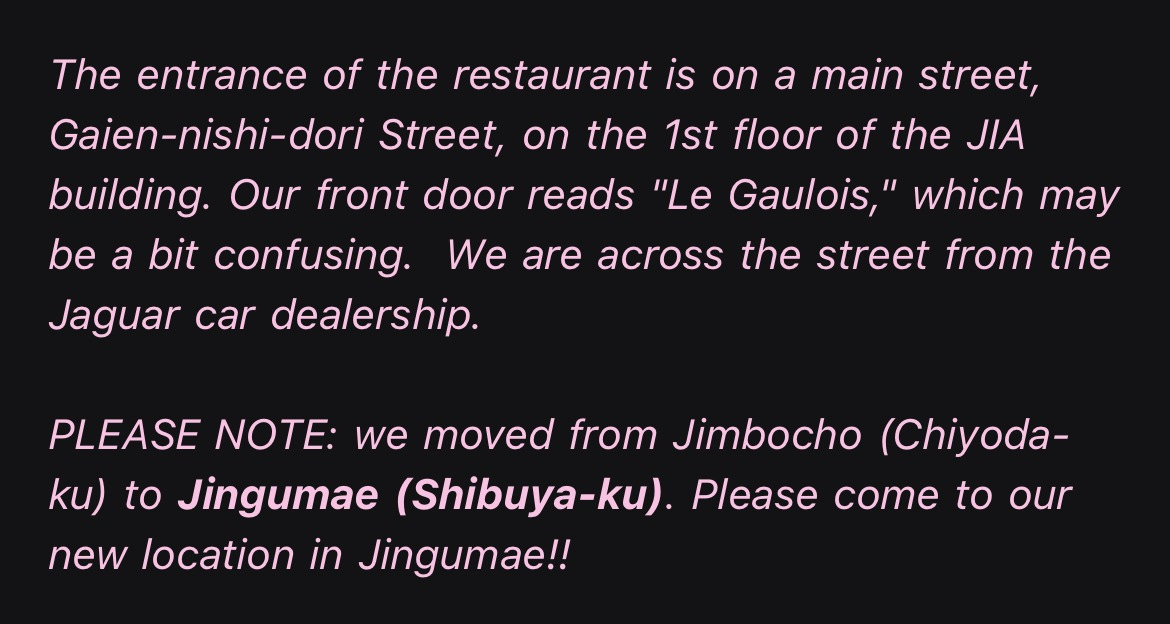
And it had a strange note about the entryway. That’s…weird. One of the most famous restaurants in the world couldn’t afford to change the signage on the door? Maybe because they had just moved into that new space…? Because the old restaurant DID explode?!
Anyway, that was a mystery to solve for later. I roamed Tokyo for a few hours thinking about how beautiful this world was and how easy life is, and then it was time for dinner.
I approached the restaurant and met the weird door.
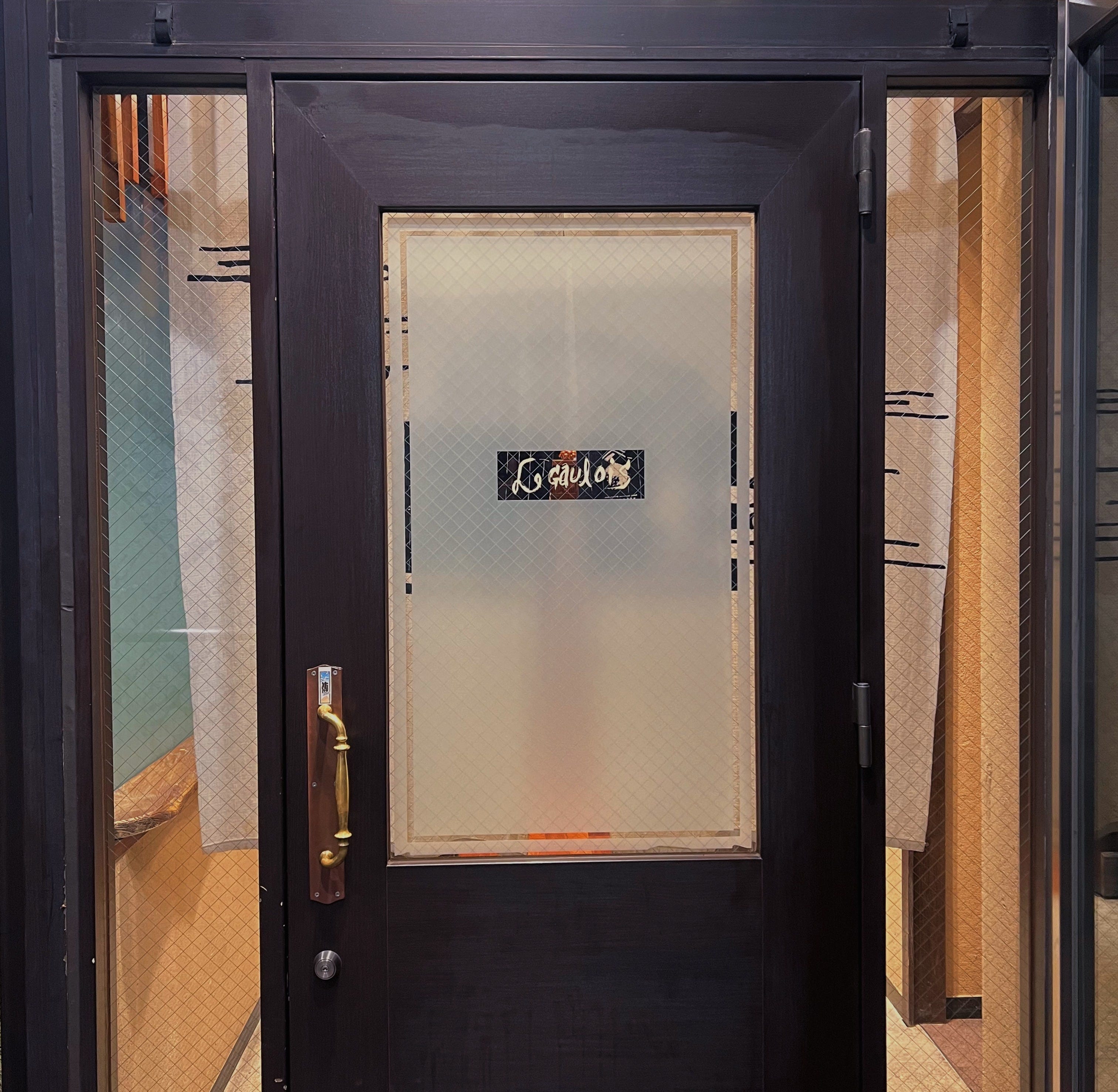


The entryway led directly toward the host stand, with various knickknacks strewn on the path there. It felt like I’d wandered into someone’s home, or at the very least, not a Michelin star restaurant. I’d never been to a fine dining environment like this before.
I was greeted at the host stand by my waitress, Noriko, and brought to the kitchen-table counter. As I sat down, I noticed a mysterious, faceless man in a black suit dining alone in a private room, visible only through an obscured circular window. Noriko caught me levitating slightly off my chair to get a peek at him.
“A guest from Brazil,” she explained. “A friend of the chef’s.”
She offered me a choice of handmade handkerchiefs, mentioning they were made by a friend of the chef’s, to accompany my meal.


I was seated with two Japanese couples to my left and a Korean solo traveler to my right. Shortly after, an American couple took the last available seats beside us. I lasted about five minutes of us awkwardly leaning around each other to photograph the space before turning towards my solo neighbor.
“So…where are you from?”
After our introductions, Jin from Vancouver told me with a sardonic smile that I’d picked the handkerchief he wanted. What can I say, I have very good taste.
The course immediately opened with a twist: a monaka wafer, typically offered as a traditional sweet, sandwiching foie gras, pickled daikon, and persimmon paste. It was very pastelike and cloying, an interesting blend of flavors.


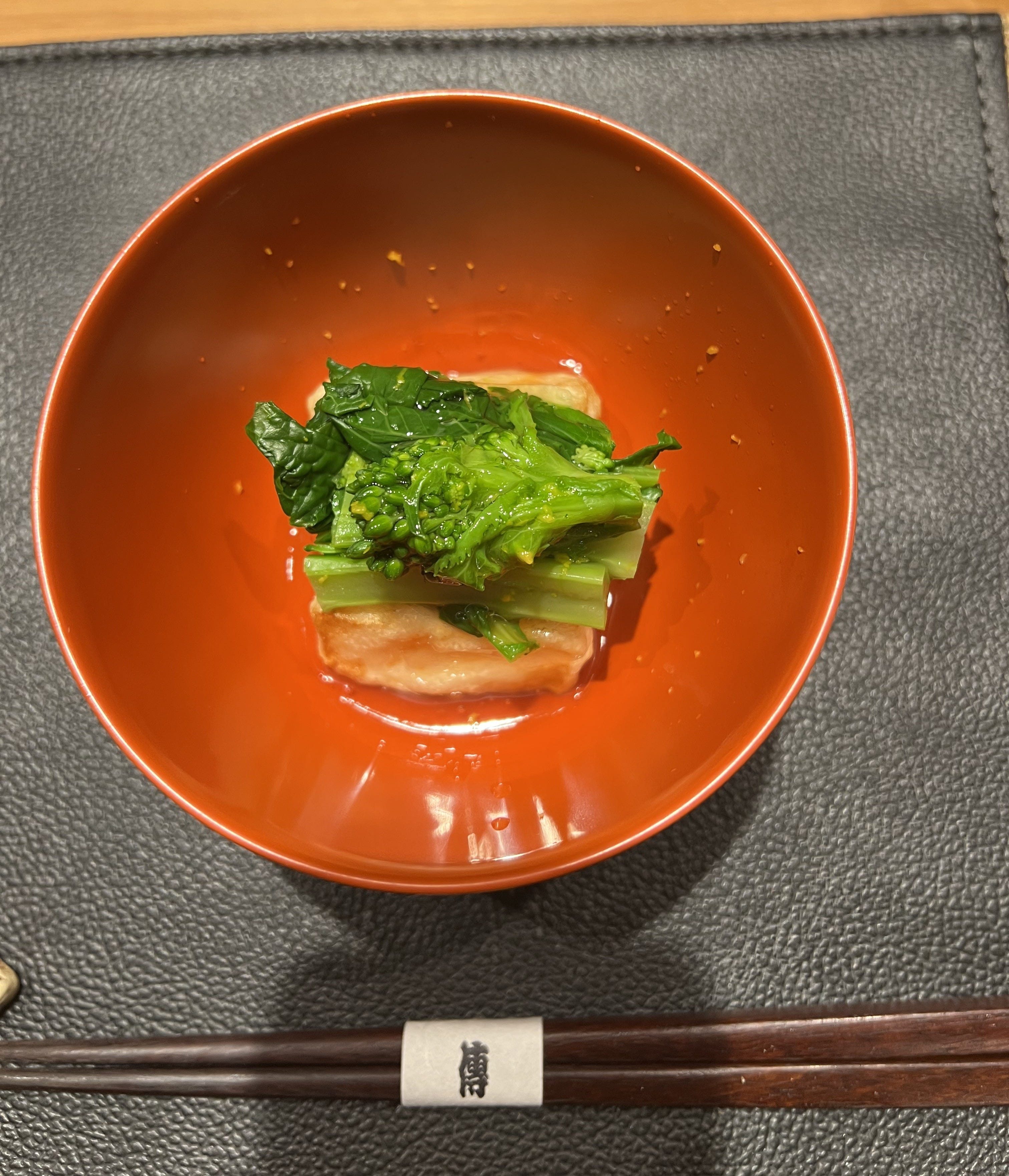
Next followed a scallop dumpling with rapeseed leaf and yuzu (every goddamn tasting menu in the world has a scallop course). The rapeseed was thick with an iron-heavy flavor, layering very nicely with the yuzu, and the dumpling skin was razor-thin. This one grew on me the more I ate.
I heard the couple to our right commenting on the food. Feeling sufficiently emboldened, I craned my neck to peek over at them. “It’s good, isn’t it?”
With this the four of us fell into steady conversation with each other as the meal progressed.


Den’s plating is simple, almost minimalist, but it’s fun. The next course was their famous dentucky fried chicken, and the chicken wing was crispy and juicy, sour from the pickled plum rice stuffed inside.


Next was the sashimi course, an aged sawara (Japanese Spanish mackerel — no, I don’t know why the fish is both Japanese and Spanish) with wasabi and nori seaweed sauce. The sauce looked like mulukhiyah, which was deeply triggering to me, but thankfully it was much, much more delicious than green snot soup.


And while I didn’t get the drink pairing, Noriko offered me a shot of sake with the sawara course so I could join my fellow diners. We kanpai to Chris and David’s anniversary, and to me and Jin’s travels.
After the shot, I turned the cup over in my hand, admiring the unique shape. It reminded me of a shark egg.
“These are custom ceramic cups that were made by a friend of the chef’s,” Noriko chimed in. Serious points to the hospitality here — I can’t believe they’re anticipating my questions before I even ask them.
And I’m starting to realize that damn near everything in this restaurant is crafted by a friend, gifted by a friend, or designed by a friend. I felt like I needed an hour of poking around to ask the team about all the odds and ends scattered throughout the space.


I always write notes on my phone at tasting menus—my friend Josh tells me this is gonna scare restaurants into thinking I’m some high-profile reviewer, but if a chef sees a gigantic keylight getting pointed at the food and still believes I’m exercising the discretion a reviewer needs, that’s their problem.
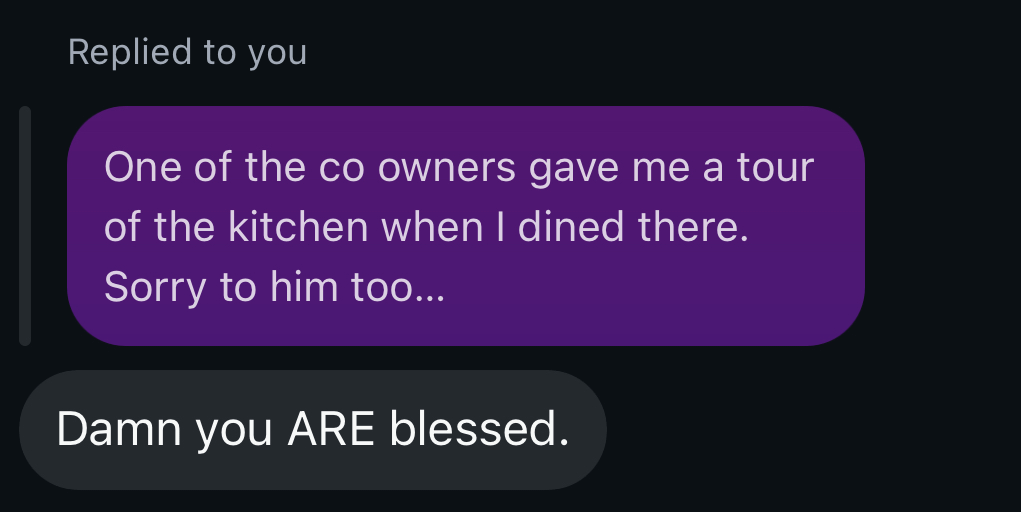
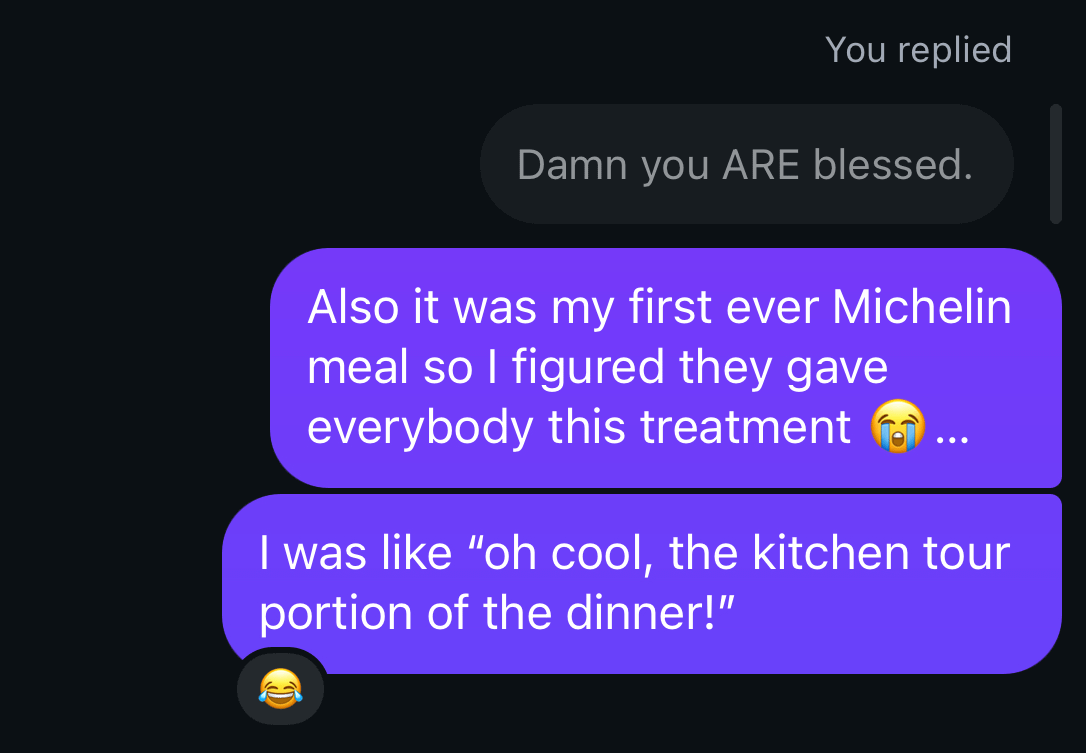
And usually my notes are just on the food – tastes, vibes, a rating. But at Den, they’re interspersed with stories from the people around me – Noriko’s favorite ramen spots, highlights from Chris and David’s recent visit to Vietnam, Jin’s worldwide restaurant shortlist. I’ll include them all at the end of this piece.
Beyond what I was learning about the meal, I was collecting memories that were precious to other people—what drew them here, where they’d been that they loved, and where they were excited to go next. We lit up over the destinations we’d shared, swapped tips for where we were headed, and discussed why we wished to see or experience certain things. I only wish I understood more Japanese so I could hear all of the stories around me — not just the ones being communicated in English.


The next courses turned out to be my favorites of the night: the “20 vegetables, 20 ways” salad, with each veggie on the plate prepared a different way. The kale chip, aged potato, konbu seaweed, and tomato were my favorites. After that, the beef cheek stewed in dashi broth with deep fried brussel sprout and sweet leek was absolutely heavenly. It was very rich and robust with a gamey beef flavor, and the vegetables were perfectly textured and paired with it beautifully.


The head chef and owner wandered over and started showing pictures of his dog to Chris and David.
“Puchi,” he said, pointing at a photo of self and dog on the phone.
I squinted at the scraggly little white and brown thing on the screen. “Puchi like Italian fashion.”
“YES!”
(I know that Puchi just means “tiny” in Japanese, but I appreciate that he indulged me anyway. You can follow him on Instagram here.)
I cannot talk about the meal at Den without talking about Zaiyu Hasegawa. His restaurant is basically one gigantic, neon-lit sign that screams “ME!!! ME!!! THIS IS WHO I AM!!!”
The son of a geisha, he sought to highlight the traditional Japanese cuisine he grew up eating at home. His mother worked in Kagurazaka, a neighborhood known for its kaiseki and French influence. That neighborhood was also where he worked his first job as a chef.
The next day I traveled an hour south to Kamakura, where I fell into conversation with a Swiss family while walking on the beach. They spent much of it telling me how completely they’d fallen in love with Kagurazaka during their stay in Tokyo. At the time, I didn’t even know the history it shared with the meal I’d just had the night before. How’s that for serendipity? I ended up writing much of this piece hopping between its various cafes and patisseries, and I’m hoping to squeeze in another kaiseki meal there before I leave Tokyo. Recommendations welcome.


Zaiyu’s wife Emi Hasegawa, affectionately referred to as the “big boss” by the team, is the front of house manager. I watched her effortlessly flit between tables in her kimono, chatting breezily with guests as if they were all old friends (hell, some of them probably were) while directing the team as well. I felt like I’d gotten access to their supper club that they had somehow managed to scale into a Michelin-starred restaurant.
As for my subjective thoughts on the food, I’m someone who likes extremes of flavor and indulgently elaborate presentations – which I knew was basically the opposite of what Den was offering when I walked through the door. But that’s also why I wanted to go here. I knew it wouldn’t be aligning exactly to my tastes, and that was exactly why I should be there.
Kaiseki cuisine is characterized by seasonality and letting the natural flavors of ingredients shine. For that reason, the flavors may seem delicate to those with different palates. If you go in expecting, well, extremes of flavor or elaborate presentations, you may mistake that intentional simplicity for a lack of impact. While Hasegawa does do some quirky things with the food, the meal isn’t translating itself for you. It is still kaiseki, so frame your expectations accordingly.
It’s also worth mentioning that the iconic mainstays like the rice-stuffed chicken wing and salad-twenty-ways have been on the menu for over a decade. Those already familiar with Den from the hype may also feel disappointed if they only walk in expecting new gimmicks. (Though Noriko did tell me that the menu changes for repeat diners. Then after seeing the imminent despair on my face quickly added that it’s way easier to get a second reservation after you’d already suffered once!)
This is why I highly encourage doing your own research by trying a traditional kaiseki meal before going to this one. It will help you better appreciate the creative twists that may pass you by otherwise. And I imagine there are so many tenets to this meal meant to evoke nostalgia that completely passed me by. There’s a whole layer I’m probably missing, but that didn’t make the experience any less special to me. If anything, it made me want a second visit.
So no, it wasn’t my absolute favorite meal in Tokyo, but it was pretty damn far up there. And I think it’ll definitely be the one I remember most. My advice to you? If you get a seat at the counter, lean into it: talk to your neighbors, talk to your server, and let the night give you one—or two, or a dozen—new things to learn.
And while Hasegawa doesn’t speak much English, he still made such an effort to connect with us, at one point coming over to show Jin and I pictures of the fish he caught on a recent trip down the Amazon River (as one does). I can confidently say this is the first and last time I’ll ever be delighted by a guy’s fishing pictures.


Our next courses include grouper, bonito flake, and pickled cabbage soup. The flavor leaned acidic thanks to the cabbage, and the broth was lovely — the grouper wasn’t my favorite and I found it a bit chewy, but I don’t really like grouper in any context.
The clay pot rice with mushrooms, and kinome leaves with dashi broth and pickled vegetables, were so divine in their simplicity. I wish we didn’t get this at the end of the meal, because I would have eaten two bowls of that rice if my stomach would allow it.
We all had a laugh at my expense as Noriko and I relay the story of my reservation troubles (turns out it was her I had spoken to earlier on the phone), and how they just so happened to have an open seat on the day I finally got through.
“Maybe it was fate, then,” David remarked.
“Maybe.”
Meanwhile, my fellow solo traveler got through on his first call. Consider the handkerchief revenge, Jin.
“By the way,” someone asks—I think Chris, because it definitely wasn’t me (I’d completely forgotten about it at this point)—“what’s with the door?”
“Le Gaulois was Zaiyu and Emi’s favorite restaurant. After it shut down, they bought the space and kept the name on the door as an homage.”
Of course.
I just had so much fun. And even though I can’t understand much Japanese, I could tell the whole room was having a good time, too – conversations buzzing, laughter spilling over the tables. At one point, I heard a chorus of surprise behind me and turned around: Emi and the team had just gifted an older woman a bouquet of flowers. She was completely startled by it, face flushing red and beaming in delight as she accepted the bouquet. I got the distinct feeling that whatever you give here, they return tenfold.
And after having experienced nearly a dozen fine dining meals at this point, I’ve come to learn that the way the team behaves is an excellent reflection of the head chef’s personality. At Den, everyone seems genuinely at ease — like a busy home kitchen at full tilt during a dinner party (okay, maybe not the best comparison to make when you say people are “at ease”, but you get the point). I later learned that some of the team have been with the Hasegawas for over a decade, and I can very clearly see why.


The meal concluded with a black bean ice cream with kiwi and red bean topping, paired with a light tea. I loved both. I’m usually really anal about getting the details down with my notes, but I was too busy talking to remember the exact tea I drank – sorry!
Hugs were exchanged (yes, including with Hasegawa – he’s notorious for them) as we all got up to leave. I’m a sap, but I think there’s something really special about sharing meals with people you will almost certainly never see again. Goodbye and live a beautiful life!
As the hapless plebeian taking public transit home, I was the last guest in the restaurant. As I gathered my things (gift, bag, another gift) and looked around the space one last time, Puchi trotted over to the table beside me and hopped up onto a chair that had been left pulled out. Planting two paws up on the table, his tail wagged as he glanced around expectantly. One of the waiters materialized from the kitchen to place a bowl of water in front of him, which he began lapping up immediately.
It was like something out of a cartoon.
Chef caught me staring incredulously, and without skipping a beat, pointed at the bowl of water and said “sake.”
I burst out laughing. “No!!” I said in mock protest. “He’s too small!!”
I was presented with one last gift as Noriko left to grab my coat – chef motioned for me to wait as he rifled behind the host stand before procuring a small bag of something.
“Chocolates,” he said, pressing it into my palm with a wink. “For Valentine’s Day. Made by…”
Yep, you guessed it, a friend.


Despite doing this for over fifteen years, the experience didn’t feel gimmicky or performative. In a city as fast-paced as Tokyo, Zaiyu and Emi Hasegawa and their team at Den are a haven of incredible hospitality. My experience at Den is, to me, emblematic of the very best of Japanese culture and cuisine.
It was also an unexpected source of inspiration. I think I learned something very important here about what it takes to endeavor on a creative project and have it succeed — it’s gotta have your heart behind it. Behind the vision, behind the menial work, behind the people helping you bring it to reality. If that’s missing, it’s nothing. It was a really nice reminder to have, considering the reasons that brought me back to Tokyo in the first place. Not to be woowoo with it, but I think it’s another really sweet piece of serendipity that I finally got in on the day of love.
Chef Zaiyu’s family and interests are celebrated openly throughout his restaurant, but never in a way that felt egotistical to me. It’s in a way that says they’re the loves of his life. Love imbibes every corner of this space. It feels like I’m dining in someone’s home, surrounded by a lifetime of their stories. It’s a very human story.
I really feel like I got to witness something special here.
Visit Date: February 14th, 2025.
Noriko’s ramen recommendations
Ramen Maikagura
Ramen Nishino
My fellow travelers’ recommendations
Mai Chau (Vietnam)
Avana Retreat (Vietnam)
Les Galinas (Provence)
Quince (San Francisco)
Maito Restaurante (Panama)
Intimo (Panama)
Tua Madre (Portugal)
Borkonhya Winekitchen (Budapest)
And because I have very good taste, these are the ones I gave them
Tatiana by Kwame Onwuachi (NYC)
Torrisi (NYC)
Art’s Cafe (SF)
Lardon (Chicago)
Akiro Hand Roll Bar (Madrid/Chicago)
Oriole (Chicago)
Indienne (Chicago)
norm tea house (Tokyo)
cafe ataraxia (Tokyo)
What a reservation to get!!