
I love a good oyster, mussel, clam, lobster, prawn, crab. Give me a crawfish with the head still on so I can twist it open and suck the tomalley out (also called “the liver”, “flavor”, or “the good stuff” in Louisiana). Hand me a crab claw crusher and watch me go to town on that sucker.
Unfortunately I don’t live on a coast, so wholesale oysters cost a fortune to get here – mention the Whole Foods 12 for $12 and you’re getting blocked – so I usually get my fix at restaurants. And every time, I sit in the disappointment that I don’t get to do the shucking myself (and miss out on a potential in-oyster snack).
Any food that makes me crack open, prod at, suck out, and generally work to get at it is a winner in my book. It’s like it taps into some ancient reward mechanism hardwired into my lizard brain. I worked for it, so it tastes better. But how am I defining “playing” with ones’ food? I’m definitely using the term very generally. A lot of the examples I’m going to give aren’t considered “play” at all – they’re just how the food is eaten. But for the sake of this article, I’m going to use it as a catch-all term for any kind of meal that warrants interacting with the food to eat it. Whether that’s eating with your hands I’m talking about experiences as simple as eating or preparing with your hands, such as with West African fufu and egusi soup, to traditional or ceremonial practices like finding the baby in a New Orleans king cake or almond fishing in an Icelandic Christmas Eve rice pudding. It isn’t my intention in writing this to exotify any cultures or practices, merely to admire the various ways I’ve seen food being handled, celebrated, and most importantly, eaten.
Eating with your hands can sometimes be seen as a faux pas at the best of times, boorish and offensive at the worst. My aunt watches in horror as I pull meat from bone on a whole-fried fish. I remember a waitress at Din Tai Fung holding back laughter every time she saw me eating sticky beef ribs with my hands. What’s interesting to me is how the notion of touching your own food transitions as you move throughout cultures and socioeconomic classes – in place where communal food is more common and you’re eating things like mezze or wats, you’d look fucking stupid cutting into your pita or injera with a knife and fork. Conversely, trying to eat a crepe with your hands at a sit-down establishment would make you look like a slobbering rube.
Prudish superiority complexes of the utensil-users aside, I can appreciate some of the song and dance that comes with a proper meal – the one that asks for a salad fork, an entree fork, a soup spoon, a regular spoon, a steak knife, a butter dish, and a separate knife for that butter, until you’ve got a cacophany of instruments laid out in front of your plate with a very specific order of operations to how they should be tackled. I actually like it. Truly. I think it can be worth celebrating on its own. At the end of the day, I’m a girl who loves luxury, and I’ll pay the price of decorum to participate in it.
What I don’t like is when this prim-and-proper dining experience doesn’t realize that it has a time and place, too. It boasts no inherent superiority to any other type of dining, no matter how much ceremony they wrap it up in. When the purported “superiority” of this song and dance is weaponized by a snivelling prude to turn their noses up at “inferior” cuisines (because you know they really want to say “cultures” instead), you know you’re dealing with someone who doesn’t truly love food.
Thankfully, these opinions belong to a pretty obnoxious, out of touch, and dying minority. Attribute it to globalization, greater access to travel, viral tiktok recipes, or whatever else–but being adventurous with your food could even be considered trendy now, a cultural rite of passage. You want to look cultured to your friends. You want to tell them where you ate before anyone else in your social circle does. It may not even be about eating the food. It’s about being seen eating the food, about letting everyone know where you ate the food, and about curating the image of someone who gets it, who belongs…everywhere.

And the real dick kicker here is that the same people pearl clutching over “uncivilized” dining practices are the same ones who will gladly shell out hundreds of dollars for an interactive, eat-with-your-hands meal so long as it was ideated by a white guy who went to Cordon Bleu. Practically every fine dining experience I’ve participated in so far has introduced some element of playing with your food – a perverse attempt at tapping into the primal satisfaction of shucking your own oyster or gently demolishing a pani puri.
That isn’t anecdotal! The Alchemist’s dining experience literally begins with a pani puri, an Indian dish where you crack open a hollow semolina shell and spoon in some delicious fillings, before dunking it into a flavorful, spicy water. A few months ago I was at a cool oyster omakase experience where one of the dishes was hidden in a treasure chest, unlocked by a key we received earlier in the meal. Alinea blows up a green taffy balloon for you to suck the air out of. Ever has you pick your chocolates out of a real wooden log. Ortolan is probably the strongest example of “food-play” that I can think of. Out of respect to the deceased avians, I should actually refer to it as a ritual, because there isn’t really anything playful about it. And it begins long before dish hits table. The little songbirds are captured in nets during their migratory season in the south of France. The caged birds are then kept in total darkness for a month, blankets draped over the cages. Sounds cruel, right? Positively soft compared to what they did before the modern era – gouging the birds’ eyeballs out with needles. I hesitate to assume this change was a measure of animal welfare. Maybe chefs just decided they wanted intact eyeballs included in the experience as well.
They are kept in darkness as they only feed at night. Circadian rhythms sufficiently disrupted, the birds engorge themselves on food for weeks, growing two or three times their own size. Once the bird is sufficiently fattened, it is killed by drowning in French brandy, and then cooked in its own fat. As the roasted birds arrive at the table, diners drape handkerchiefs over their heads before indulging in the meal – so as to hide their shame from God. The bird is eaten in one go, chewed whole, with only the beak left behind – brittle bones break apart and cut into the gourmand’s mouth as they chew. Apparently, the metallic taste of your own blood complements the flavor of the whiskey.
I won’t ever commend such cruel treatment of an animal – a post-mortem syringe can achieve what I assume drowning is intended to do (distributing the armagnac through the bird’s body) just fine. But, these sadists would argue, that simply isn’t as enticing. It kills the story. And our minds are just as hungry as our stomachs – the cruelty, the bizarreness, the ritual and the story is exactly what makes it taste better.
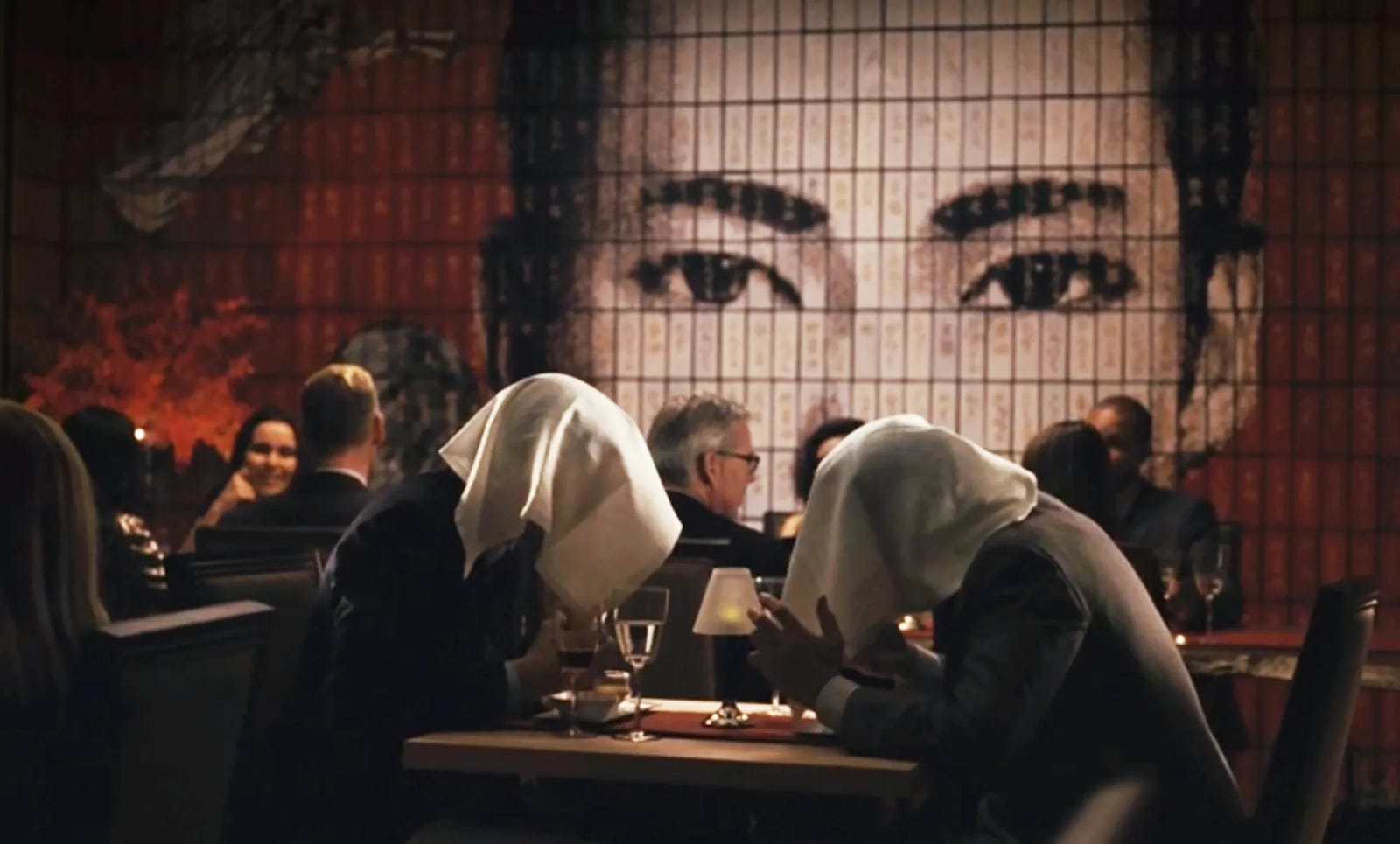
Dining is language. Dining is culture. Dining is religious, it’s cult-like, it’s ceremony. The table is the center of home and community. When comparing life now to your childhood years, it feels so droll because you have fewer novel experiences. Discovery is youth. Granted, we have to make sure that youthful drive for newness does not pervert itself – to introduce ceremony to one’s food isn’t enough. One must respect its source, and if you’re a meat eater, you better make damn sure you understand what’s happening to your next indulgence before it hits your plate. All in all, be joyful. Enjoy your food. Respect your food. And next time you make popcorn, eat it with chopsticks.
And if anyone ever laughs at you for ordering a messy sandwich on the first date, or, god forbid, daring to eat with your hands – ignore them. They’re part of a laughably small minority. There’s no need to perform while you eat. We’re already doing it everywhere else.
A bookmark for myself to listen to eventually: https://www.thisamericanlife.org/343/poultry-slam-2007/act-two-2