


That’s an excerpt from Susan Lepselter’s The Resonance of Unseen Things, an ethnography of UFO believers in the American Southwest. I read it for a class this quarter, and the Coda got me thinking about my own Southwestern misadventure.
On my first-ever solo trip, my car broke down outside of Death Valley.
Was it hubris that made Death Valley my first National Park? The answer is yes, of course, I had just driven in from Vegas. And I chose Vegas for my first-ever solo trip because I adored Southwestern American mythos. Well, here was my opportunity to experience it firsthand.
The unfortunate events transpired in Rhyolite, a ghost town just outside of Death Valley and about two hours northwest of Vegas. My evening plan was simple: visit the famous ghost town, grab some gas and dinner in Beatty before sunset, then head down south to stargaze at Badwater Basin. In the largest park of the lower 48, that meant about sixty miles — over an hour’s drive — with no cell service or other people reliably nearby.
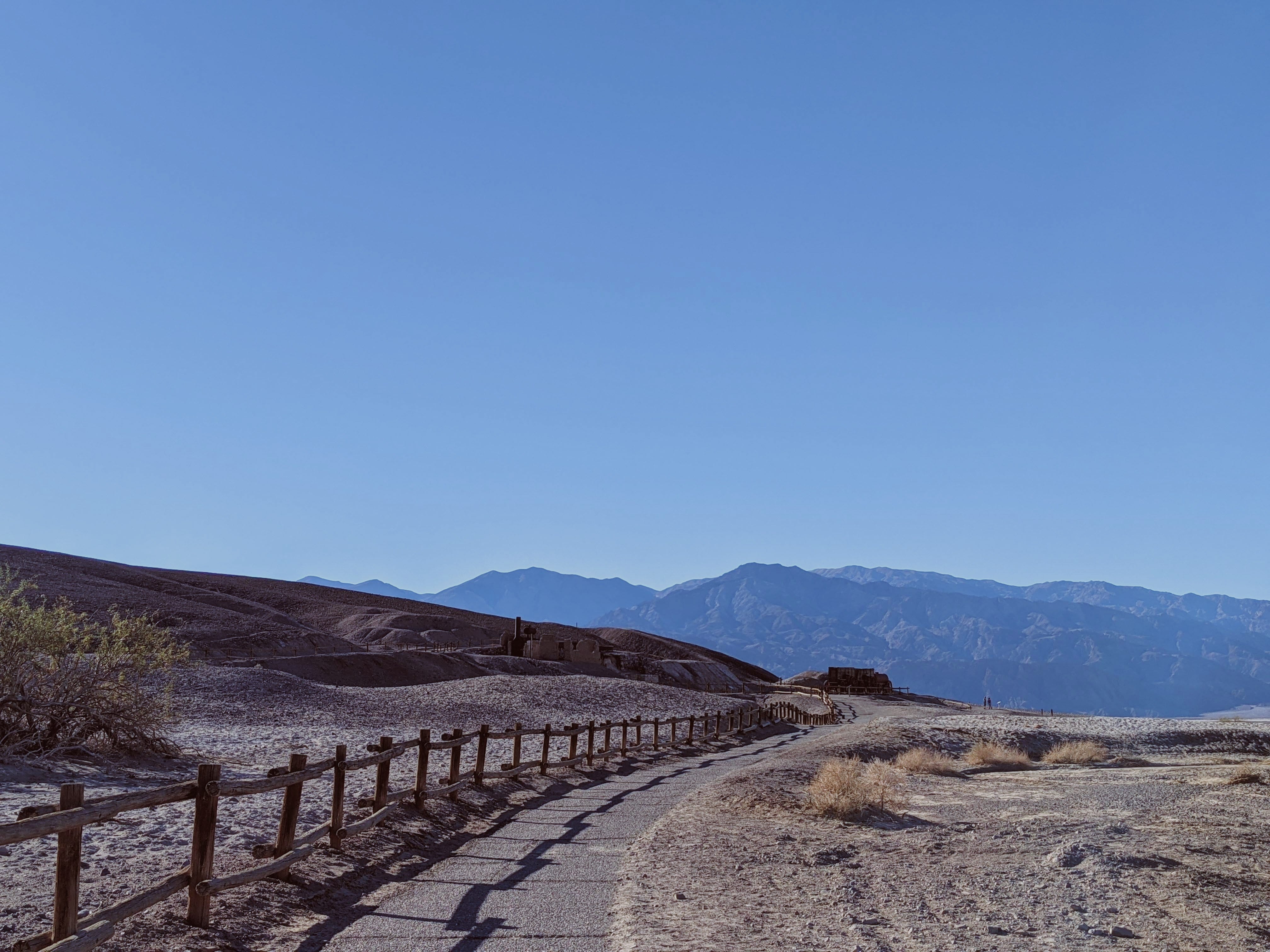
I arrived in Rhyolite exhausted after a full day of driving. There were two other cars when I got there — one belonging to an older couple also milling about, and a large black Ford truck occupied by two men that kept circling around the area.
I didn’t find the town particularly spooky beyond some crumbling infrastructure and eclectic statues strewn about, until I wandered into one of its abandoned buildings and a gust of wind slammed the door shut behind me. I jumped, and felt the house shudder in response.
When I came back out, the couple was gone. The men in the truck had stopped, watching wordlessly as I walked out. All I could hear was the wind, the gravel crunching under my feet, and the low hum of a working engine. I could feel their eyes on the back of my head as I moved.
Growing nervous, I covered the rest of the distance quickly, started the ignition, and followed the GPS directions out. Frazzled and tired, I didn’t realize until I’d passed their truck that the GPS wasn’t taking me out the way I came in.
I reached the end of town, seeing the road transform to gravel shortly ahead. This wasn’t the road I came in on, and it didn’t look safe to drive on — some of those rocks looked big, and my car’s clearance wasn’t very high. But I also didn’t want to double back past the men and advertise that I had no idea where I was going.
I gingerly began to drive down the road, then almost immediately regretted it. No, this was wrong — my fear of the men was imagined, but potentially puncturing my tires was a reality. There is no cell service, it’s my first time alone and it’s in a desert ghost town, my car should not be on this gravel, and these men are potentially watching me. I need to go back. I will be followed if I go back. I will get hurt, because of…ghosts? Men? Heatstroke????
I quickly reversed out and drove off the way I came, ignoring my nav app’s squawking insistence that I turn around and go back down that gravel road. The black truck pulled out behind me — maybe because they were also leaving — or were they following me? I peeled off the town road and sped towards Beatty.
All the while, that disembodied woman’s voice kept insisting, with what seemed to me an increasing fervor, that I turn back around and go down the gravel road. It wouldn’t shut up until Rhyolite was in my rearview. I think I actually had to force quit the app myself.
When I got to Beatty and pulled into the gas station, the black truck had disappeared. I breathed a sigh of relief and began pumping my gas, still a bit rattled from the comedown of my panic, until I saw the black pool of liquid coalescing under my car. The oil pan had been punctured, and the sun was rapidly setting.
I obviously made it back to Vegas safely, thanks to the grace and generosity of a friend. But the point of sharing this story is that my own imagination had outrun me and put me into danger. I never found out whether those men were actually dangerous, but my reaction to the situation had made it more precarious.
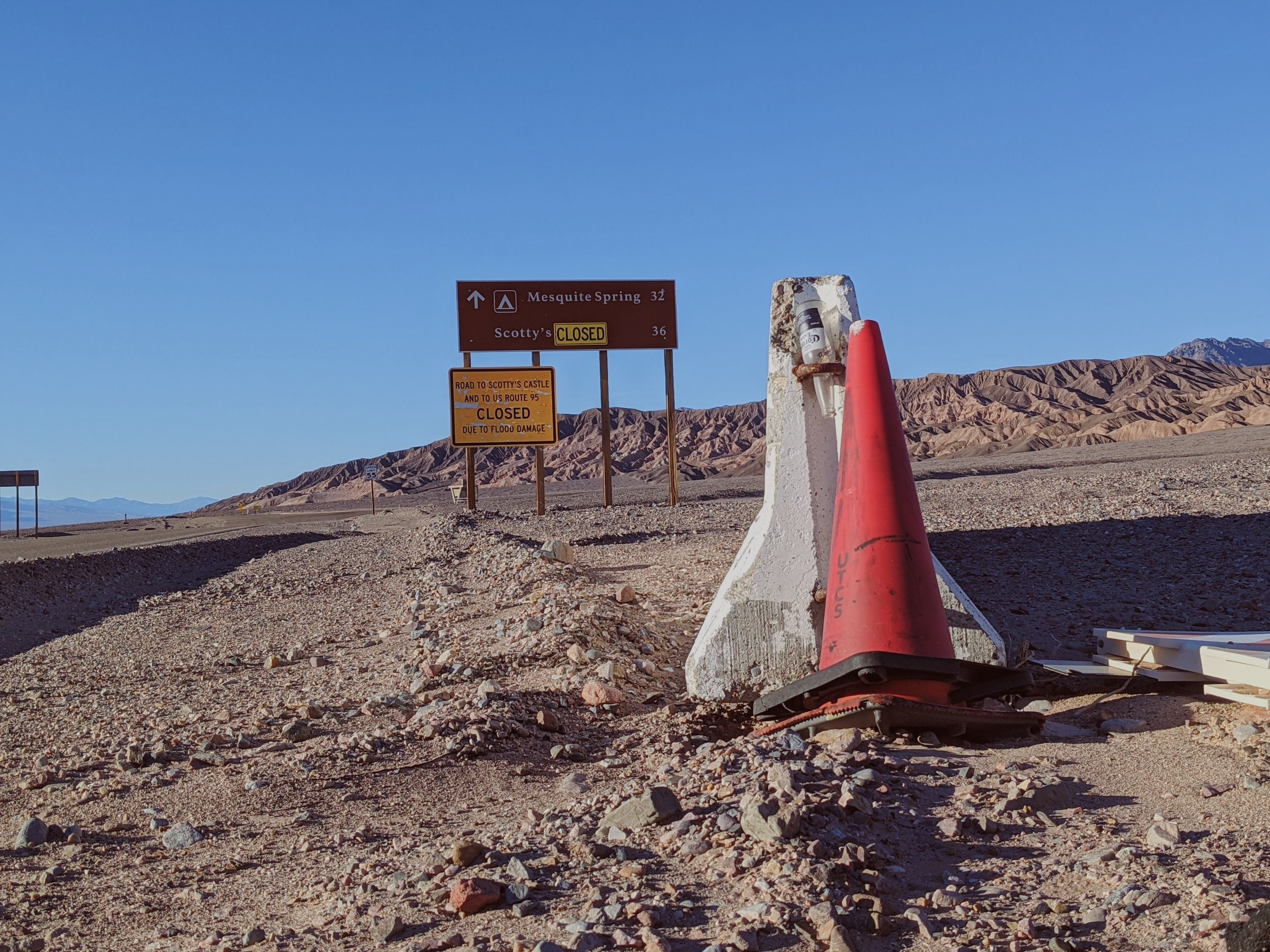
And maybe it’s paranoid to say that visiting Rhyolite placed a curse on me, but I will say my navigation apps began failing me in increasingly strange ways afterwards. I once shared this story with my brother’s girlfriend as I drove her to her new apartment in The Loop. Google Maps routed us to an abandoned loading dock in Lower Wacker instead.
Another time, as I told this story to a colleague while we drove to the airport, we nearly got T-boned by a car that ran the red light at full tilt. Call it a sense of preventative apophenia, but I stopped sharing this story in cars. An isolated navigation failure is a navigation failure. One mishap during a car ride is a mishap during a car ride. Two becomes, well…
Once more, I shared this story with a friend over coffee while we both worked remotely, from the safety of a cafe (don’t worry, no cars barreling through the storefront here). She fully leaned into it, quickly tracing the sign of the cross over her chest as I finished recounting the story. Then she looked me dead in the eyes and, in a low voice, told me that her husband’s car had also broken down outside of a Southwestern ghost town. The mythos had gone social, and moved beyond me.
And it was the initial seepage of that folklore into my own belief system — that something was potentially amiss in this town — that led to, well…something amiss happening to me in that town. The past is retroactive, the future is anticipatory, and the present becomes the stage where we desperately try to gather evidence for the truth of both.
Would I have regarded those men with as much suspicion if we weren’t in a “famously haunted” location? In my growing fear, I had wanted to ascribe the discomfort and uncertainty I was feeling onto something larger and explainable, which changed my behavior and put me in actual danger. I had watched my own interpretation of the situation become causal in real time. Lepselter likewise knew, rationally, that years of accumulated folklore were influencing her perception of that vitamin salesman — and yet she still couldn’t shake the uncanny feeling of seeing that eccentric stranger as a “Man in Black.”
I felt drawn to the desert over a shared national fantasy of exploration — open spaces, the uncanny southwest, no other people for miles. I went from unbridled joy over being in this vast open space with no other people around for miles, to the horrific realization that I was in the geographic equivalent of a blast furnace with no other people around for miles.
Retrospectively, my shitty GPS system went from being a shitty GPS system that happened to be giving me bad directions to some disembodied thing trying to send me somewhere bad. One time was an incident, two became causal. And better to exercise caution than risk anything, right?
My experience became uncanny precisely because I could no longer cleanly separate what was happening from what my interpretation of events was causing me to do. Causality and interpretation dropped acid together, and became inextricably enmeshed.
Still are. I don’t tell this story in cars, and I hate Google Maps.